
The Category
The System of Trust
The next enterprise infrastructure layer
Every era of enterprise software is defined by a system category. The System of Trust is the category for the digital economy — and the Trust Network Operating System (TNOS) is its implementation. Canonical definition →
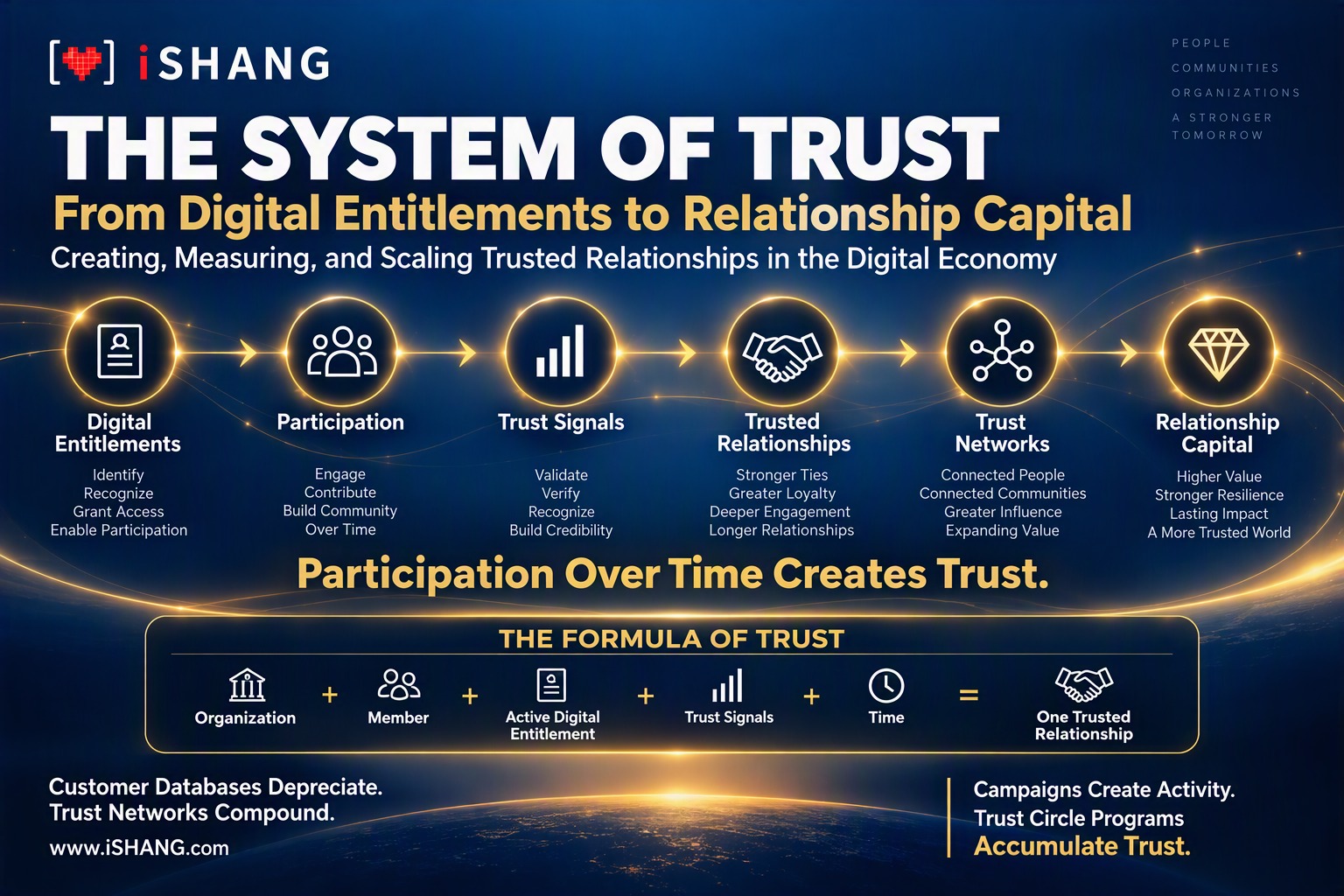
The System of Trust — from Digital Entitlements to Relationship Capital. Participation Over Time Creates Trust.
As covered in the evolution of enterprise systems — Systems of Record captured data, Systems of Engagement orchestrated participation — a System of Trust is the next enterprise infrastructure layer: it creates, measures, and scales trusted relationships.
Definition
What a System of Trust Is
A System of Trust is the enterprise system category that creates, measures, and scales trusted relationships between organizations and their participants — turning verified participation into Trust Networks and Relationship Capital.
Create
Trusted Relationships are formed through verifiable participation — not assumed from transactions.
Measure
Trust Signals quantify trust growth and relationship strength across eight signal types.
Scale
Trusted Relationships aggregate into Trust Networks — persistent, compounding, organization-owned.
Why Now?
AI, automation, agentic workflows, distributed organizations, and digital ecosystems are increasing the importance of trusted relationships.
While organizations have systems for managing information and engagement, they increasingly need systems for creating, measuring, and scaling trust.
The System of Trust is the answer.
Why It Is Different
From CRM, Loyalty, and Community Platforms
CRM
Stores records of what happened
✗Cannot measure whether a relationship is trusted
Loyalty
Rewards repeat purchases
✗Points expire; the database depreciates
Community
Orchestrates interaction
✗Activity without accumulated, verifiable trust
The System of Trust does not replace these systems — it adds the layer none of them provide: verified, compounding trust.
The Framework
How TNOS Implements the System of Trust
Trust Circle Programs
The operating model — persistent trust assets
Strategic Campaigns
The mechanisms that create participation
Digital Entitlements
The instruments of trust
Trust Signals
The measurement
Trusted Relationships
The North Star KPI
Trust Networks
The strategic asset
Relationship Capital
The outcome
The Doctrine
The Core TNOS Doctrine
1 · The Venue Principle
The Trust Circle is the venue. The Campaign is the episode.
2 · The Participation Principle
Campaigns create activity. Trust Circle Programs accumulate trust.
3 · The Compounding Principle
Campaigns end. Trust compounds.
4 · The Continuity Principle
Campaigns are temporary. Relationships are persistent.
5 · The Member Principle
The member returns to the venue — not the episode.
6 · The Asset Principle
Trust Circle Programs are assets. Campaigns are mechanisms.
Frequently Asked Questions
What are the three system eras of enterprise software?
Systems of Record captured data. Systems of Engagement orchestrated interaction. The System of Trust creates, measures, and scales trusted relationships — defined by iSHANG’s Trust Network Operating System (TNOS).
What defines the System of Trust?
iSHANG’s Trust Network Operating System (TNOS) defines the System of Trust — the category of systems that operate trust as a measurable, compounding business asset.
Why do organizations need a System of Trust?
Transactions and engagement metrics do not capture relationship strength. As AI agents begin verifying trust before transacting, organizations need a system that creates, measures, and scales trusted relationships.
What does the System of Trust produce?
Trust Signals (measurement), Trusted Relationships (North Star KPI), Trust Networks (owned asset), and Relationship Capital (compounding outcome).
Is the System of Trust a product or a category?
It is an enterprise software paradigm — a system category. TNOS is the operating system that defines and implements it, created by iSHANG.
Book a Strategy Session
See how the System of Trust applies to your organization.