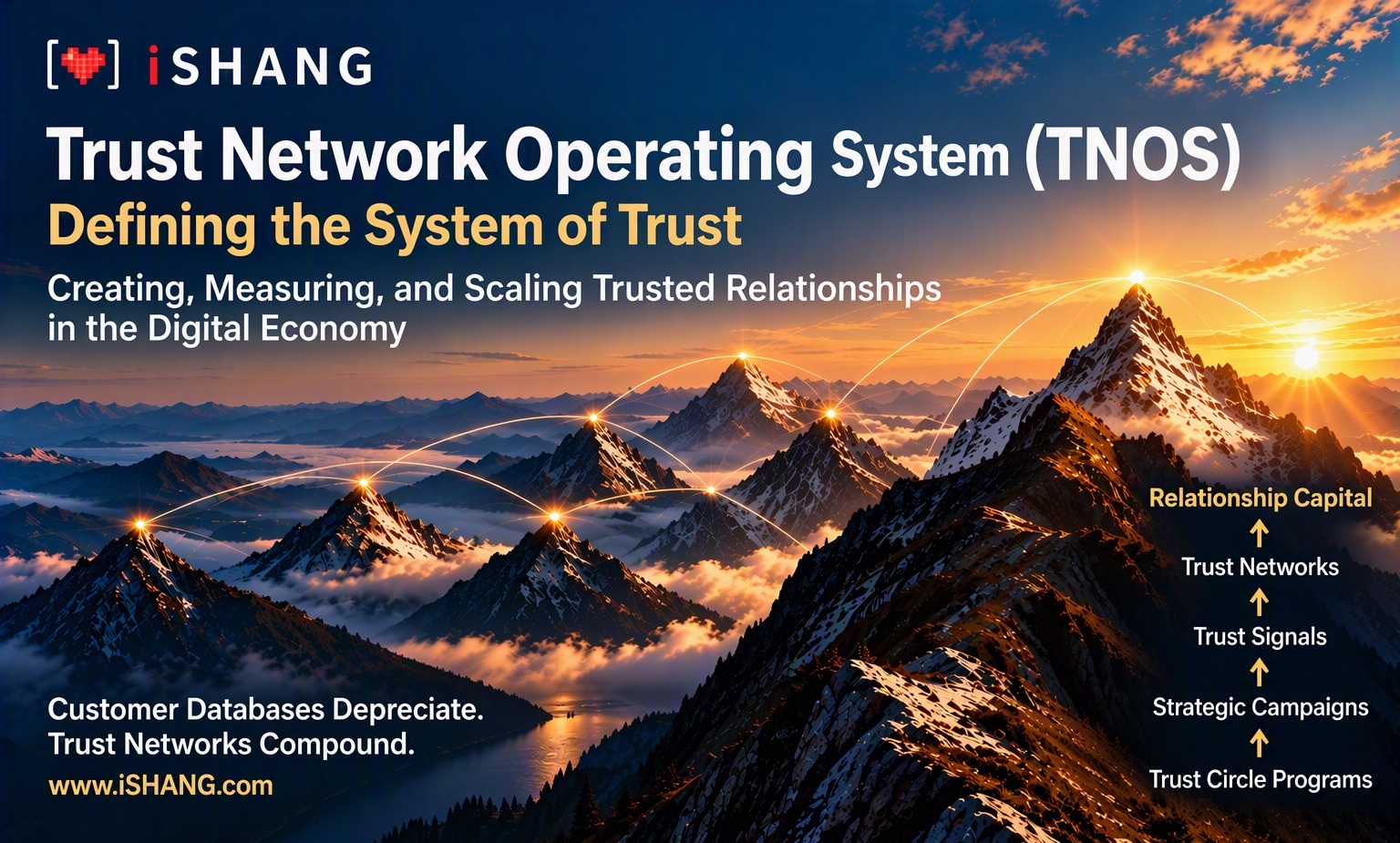
The Trust Network Operating System (TNOS)
Defining the System of Trust.
Operating Trust Circle Programs. Creating Trust Signals. Building Trust Networks. Growing Relationship Capital.
In plain terms: iSHANG helps organizations create, measure, and scale trusted relationships.
New here? TNOS is the software platform behind everything on this site. A Trust Circle Program is a membership-style program your organization owns and runs — its value keeps growing after each campaign ends. Trust Signals are the measured proof that participation happened. And Relationship Capital is the accumulated trust between your organization and its people — it compounds instead of expiring.
Why This Is Different
Loyalty Programs vs Trust Circle Programs
Loyalty programs retain buyers. Trust Circle Programs build trusted relationships with every participant — alumni, fans, volunteers, stewards, members, and buyers alike.
Transactions rewarded
Participation recognized
Points that expire
Digital Entitlements that persist
Activity measured
Trust measured — Trust Signals
Database that depreciates
Trust Network that compounds
Campaigns end. Trust compounds.
20+
Organizations
10,000+
Participants
16
iSHANG Trust Circle Programs
8
Trust Signal Types
Why Now?
Organizations have CRM. They have loyalty systems. They have community platforms.
What they do not have is a way to measure whether a relationship is actually trusted.
TNOS addresses that gap.
The Evolution of Enterprise Systems
Systems of Record
ERP · CRM
Captured and organized data.
Systems of Engagement
Community · Membership · Loyalty
Orchestrated participation and interaction.
Systems of Trust
TNOS · Trust Networks · Relationship Capital
Create, measure, and scale trusted relationships.
The Outcome-First Perspective
What Organizations Actually Buy
Organizations do not buy:
- ✗Digital Entitlements
- ✗Trust Signals
- ✗Campaigns
- ✗Technology
These are mechanisms and measurement.
Organizations buy:
- ✓Retention
- ✓Participation
- ✓Recognition
- ✓Community Growth
- ✓Advocacy
- ✓Reputation
- ✓Trusted Relationships
- ✓Trust Networks
- ✓Relationship Capital
These are the results that matter.
The insight: Organizations buy systems for creating and managing trusted relationships. Campaigns are temporary. Relationships endure.
The Trust Compounding Doctrine
Campaigns End. Trust Compounds.
The core TNOS doctrine → How TNOS WorksThe Strategic Asset
Customer Database vs Trust Network
Customer Databases Depreciate. Trust Networks Compound.
A database accumulates records that lose value over time. A Trust Network accumulates Trusted Relationships, Credentials, and Recognition — Relationship Capital that compounds.
See the full comparison → Trust NetworkiSHANG Trust Circle Programs
One Framework. 16 Programs.
Every Branded TCP is an instance of one of the 16 iSHANG Trust Circle Programs — the presets organizations build on. Six of the sixteen:
Heritage Circle
Culture, heritage, legacy
Collector Circle
Collectibles, provenance, stewardship
Education Circle
Learning, alumni, professional development
Executive Circle
C-suite, boards, leadership
Impact Circle
Sustainability, social purpose
Industrial & Resources Circle
Energy, mining & metals, commodities, agriculture, infrastructure, resource stewardship
Reference Cases
Proof the Category Works
Alumni Circle™
Gratia Christian College
Lifelong alumni engagement through verified credentials and recognition.
Education Circle
Legacy Circle™
Treasure King
Transforming collectors into lifelong community members through verified provenance.
Collector Circle
Policyholder Circle™
PSC Insurance
Building trust between insurers and policyholders through verified engagement.
Wealth Circle
Dynasty Circle™
Master Pine
Preserving family legacy and heritage stewardship across generations.
Heritage Circle
Fan Circle
Miss IMX 2023
Turning fans into an engaged, recognized entertainment community.
Entertainment Circle
Climate Action Circle
Earth Exchange
Mobilizing climate action through verified impact participation.
Impact Circle
The Bigger Vision
Built for the Agentic Economy
Today's Trust Signals will become the machine-readable foundation that AI agents use to verify, transact, and connect.
Trusted Relationships Grow into Trust Networks and Relationship Capital.
Book A DemoReady to launch?
The Trust Network Hub is the execution layer of TNOS. Register your organization, set up your Trust Circle Program, and launch your first campaign.
Organizations do not buy campaigns. Organizations do not buy digital entitlements. Organizations do not buy technology. Organizations buy a systematic way to create, measure, and deepen trusted relationships at scale.
That is what iSHANG delivers.
Defining the System of Trust.
Operating Trust Circle Programs. Creating Trust Signals. Building Trust Networks. Growing Relationship Capital.